AI tools for sales have exploded. According to the University of Texas at Dallas (UTD), the number of AI-enabled selling tools has grown to over 3,500.
UTD’s Jindal School of Management recently published its Q1 2026 Sales Technology Landscape. The chart lists thousands of different logos by use case, with some categories growing at 15% to 20% per year.
A landscape this large and dynamic presents good and bad news:
- Good news: There are likely AI tools that fit your company’s unique needs and will give you a productivity benefit.
- Bad news: Finding the right one is a challenge, like finding a needle in a haystack.
Watch On Demand: Consultative Selling in the Age of AI
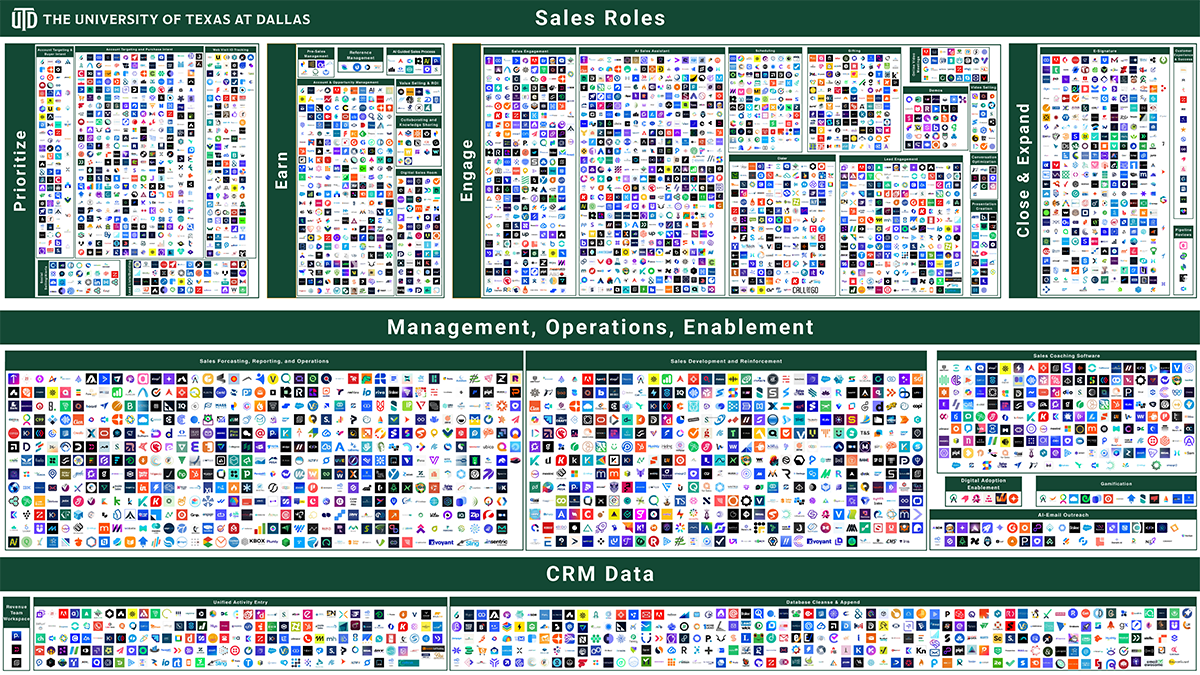
Source: University of Texas at Dallas
Top AI Tools for Sales Teams
The Brooks Group does not make specific recommendations for which technology tools to use. We try to help companies evaluate the types of tools to achieve the best development outcomes for their team.
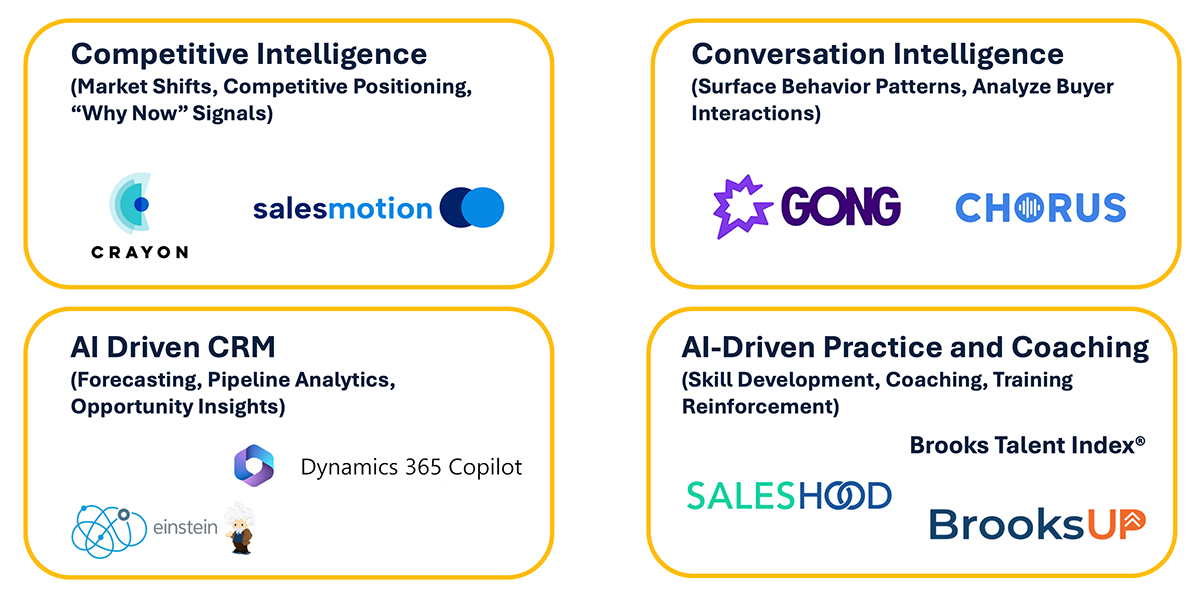
AI tools for sales typically fall into four categories that each fulfill specific needs.
| AI Sales Tool Category | Sales Need |
| Competitive Intelligence | Data and perspective on their market, prospects, and competition |
| Conversation Intelligence | Complete, accurate recordings of their interactions with prospects and customers |
| AI-Driven CRM | Insight and coaching on account strategy, stakeholder mapping, and pre-call planning |
| AI-Driven Practice and Coaching | A way to practice and receive coaching feedback on their skills |
AI Capability Ecosystem Supports a Path To Trusted Advisor
Mapping AI Tools for Sales Across the Sales Process
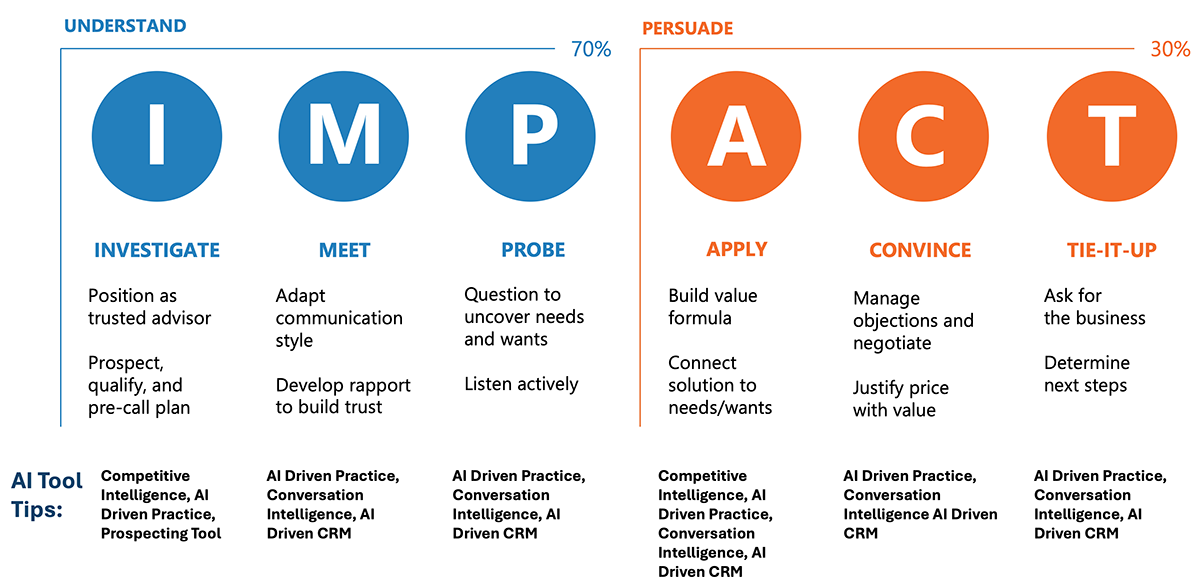
Once you understand how these tool categories work together to support the seller, you can map their use across a foundational sales process such as IMPACT Selling®.
IMPACT is an acronym representing the core stages of the sales process: Investigate, Meet, Probe, Apply, Convince, Tie-It-Up.
This sequence guides sales professionals through strategic milestones while providing proven techniques to navigate each buyer interaction with confidence.
Step 1: Investigate—Position as a Trusted Advisor
AI-powered competitive intelligence platforms help sellers understand market dynamics and identify “why now” signals. These platforms aggregate market shifts, competitor moves, and account activity so sales professionals can approach prospects with relevant insights rather than generic outreach. AI-driven practice tools help sellers refine their messaging and practice their delivery.
Step 2: Meet—Adapt Communication and Build Trust
AI-driven practice tools give sellers a safe environment where they can prepare before meetings. Conversation intelligence tools analyze real customer interactions to highlight patterns in buyer behavior and ways sellers can improve. AI-driven CRM platforms look for missing information and support sellers on planning and next steps.
Step 3: Probe—Uncover Needs and Wants
AI-driven practice tools help sellers strengthen their open-ended questioning skills. AI-driven CRM and conversation intelligence platforms help sellers capture information and recognize patterns within customer interactions.
Step 4: Apply—Connect Solution to Customer’s Needs
Once sellers understand the customer’s challenges, then competitive intelligence tools can help tailor recommendations and reinforce the value proposition. AI-driven practice tools help sellers strengthen their delivery and provide real-time feedback prior to delivery.
Step 5: Convince—Manage Objections and Justify Value
AI-driven practice tools help sellers prepare for and practice handling objections. Conversation intelligence platforms measure customer response and help sellers capture what was discussed and refine their approach over time.
Step 6: Tie-It-Up—Gain Commitment and Determine Next Steps
AI-driven practice tools help sellers refine the close prior to delivery. Conversation intelligence and AI-driven CRM summarize historical activity and ensure the necessary information and buying signals are there, building confidence in the seller to ask for the business.
How to Evaluate AI Tools for Sales
Here’s a practical framework for evaluating AI tools for sales.
1. Define Your Needs and Goals
Identify the specific problems you’re trying to solve—lead scoring, forecasting, call coaching, outreach automation, CRM hygiene, etc. Prioritize by impact and urgency so you’re not evaluating tools in a vacuum.
2. Build Your Evaluation Criteria
Score tools across dimensions like: accuracy of AI outputs, ease of use for reps, integration with your CRM/SEP, vendor support, security/compliance, and total cost of ownership.
3. Involve Your Team
Get input from frontline sellers, operations, and RevOps before shortlisting. They’ll surface practical objections and adoption risks that leadership often misses.
4. Run a Pilot
Pick a small, representative group of sellers and a defined time window (4–8 weeks). Set clear success metrics upfront: conversion rates, time saved, pipeline coverage—not just usage stats.
5. Plan for Change
Adoption is the hardest part. Before signing, have a rollout plan: training, a champion seller network, reinforcement in team meetings, and clear executive sponsorship.
6. Measure Adoption and Behavior Change
A tool nobody uses is worthless. Track whether sellers are actually changing their workflows and behavior, and not just logging in.
The biggest mistake sales leaders make is skipping steps 1–3 and jumping straight to demos, which means vendors frame the problem for you rather than the other way around.
Making the Most of AI Tools for Sales
Artificial intelligence (AI) is well positioned to amplify the skills of capable sellers. But in the near term, it won’t compensate for mediocre sales behavior.
Based on our research, successful sales teams prioritize:
- Having a customer-centric focus in their selling process
- Being targeted and intentional in positioning and pre-call planning
- Executing customer-centric fundamental skills (qualifying, questioning, solution positioning, objection handling, closing)
Sales leaders must make sure their teams have the skills and confidence to sell. Sales teams can and should use AI, but only when they have core consultative skills to build on.
While AI tools for sales can dramatically improve efficiency and insight, they are most powerful when paired with a consistent selling methodology and strong human relationships.
Technology can surface data and patterns, but the sales professional’s ability to build trust, uncover motivations, and communicate value remains the most important factor in winning business.
Contact us if you’d like to learn how AI and modern sales technology can reinforce IMPACT Selling within your organization.