There are close to one million industrial and manufacturing salespeople in North America. Some sell for OEMs, others for distributors. Some sell for large enterprises, others for SMBs.
While products, channels, and end-use markets differ company by company, there is one thing these sellers have in common: a background, interest, or affinity for what they sell.
This can come from education (an engineering or technical degree), a family connection (your dad was a crane operator so you sell crane capacity), or a skilled connection (you were a helicopter pilot and now you sell helicopters).
The common characteristic of these sellers is technical expertise.
But we learn from studying sales that just because you know a lot about something doesn’t mean you can persuade a customer to buy it from you.
Industrial and manufacturing organizations often make the decision to place technical individuals in sales roles because they see a combination of two characteristics:
- This person knows the product.
- This person can talk to people.
But is the ability to speak with people enough? This is exactly where consultative sales training comes in.
Is Your Sales Team Seller-Centric or Customer-Centric?
We studied the behavior, motivation, and selling skills of 1,000 industrial and manufacturing sellers. We found that 74% of them qualify as High Influence in a DISC assessment.
74% of manufacturing sellers qualify as High Influence.
DISC is an acronym for four personality components: Dominance, Influence, Steadiness, and Compliance. You may hear people refer to being a “high I” or a “high C.” Everyone has a primary style and some degree of the other styles.
A “High I” means these sellers come across as magnetic, enthusiastic, and friendly in their communication. They can talk to people. This is a great strength to have in sales.
But when we dig deeper and look at the motivational profile of these same individuals, we find that two-thirds of them lean more toward being resourceful, objective, and intentional rather than selfless, harmonious, and altruistic in their work and focus.
What does this mean? It means that, while they have the confidence and skill to converse easily, they’re intensely focused on the job at hand and on the best use of their time and energy.
Like an engineer looking at a process, they want to move deals forward and get deals done. They see the customer as a necessary part of this process, but they are primarily focused on the process and the outcome. There are a lot of benefits to this mindset, but there is often something critical missing: a true curiosity about and appreciation for the customer.
The customers these sellers meet with feel this. They sense that they play a role in the meeting but are not the center of that meeting.
People who are selfless, harmonious, and altruistic have a natural curiosity and concern for others and a desire to build relationships with customers that go beyond the next deal.
Benefits of Consultative Selling Skills
Moving from a seller-centric to customer-centric approach is the missing piece in helping sellers who are technical experts become trusted advisors.
In fact, we can see exactly where this motivational profile hampers sellers when we look at their knowledge and ability across common sales process stages.
At The Brooks Group, we use a sales assessment called the IMPACT Selling Skills Index® (SSI) to assess an individual’s thinking prior to training.
The SSI determines hard sales skill levels and diagnoses gaps in the context of a consultative sales process such as IMPACT Selling®. IMPACT is an acronym for a six-step process: Investigate, Meet, Probe, Apply, Convince, and Tie-It-Up.
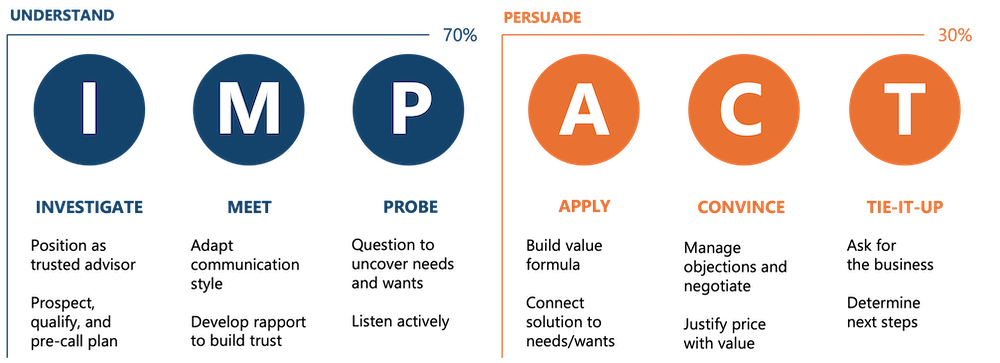
The SSI reveals how well someone understands the basic principles of investigating opportunities, planning and conducting meetings, doing probing and discovery, applying solutions, convincing around that solution, and tying up deals.
In short, how well do they know how to do customer-centric, consultative selling?
Research Shows Where Manufacturing Sellers Underperform
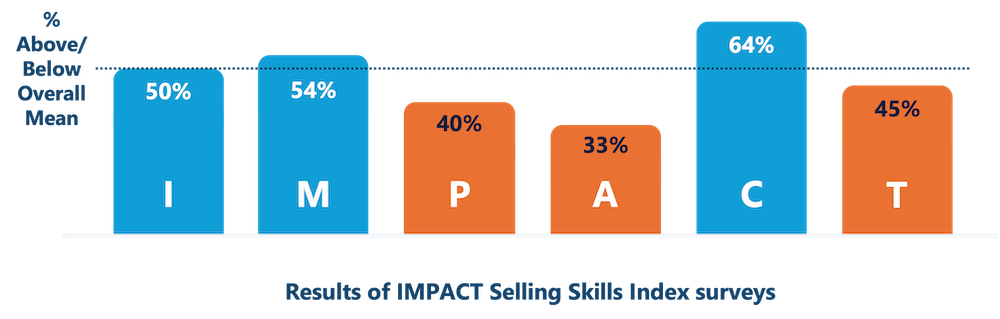
We’ve given this assessment to over 17,000 individual sellers. When we look at a group of 1,000 industrial and manufacturing sellers and compare them to the broader population, we see some interesting trends in where they are strong and where they need development.
- Average Performance at Stage 1 (Investigate)
In the chart below, you can see that industrial and manufacturing sellers perform right at the average when it comes to investigating opportunities (no better or worse than the overall population). - Over-Performance at Stage 2 (Meet) and Stage 5 (Convince)
On the other hand, they over-perform the average when it comes to executing meetings, managing objections, and confirming interest. - Under-Performance at Stage 3 (Probe), Stage 4 (Apply), and Stage 6 (Tie-It-Up)
But they fall well below the average when it comes to probing for needs and wants and applying what they’ve learned to a tailored, relevant solution for the customer.
That’s the main difference between consultative and seller-centric selling. Consultative selling skills help salespeople read each situation, ask probing questions to uncover customer needs and wants, and earn credibility before ever recommending a solution.
Sellers who can’t articulate how their solution addresses a specific challenge find it much more difficult to close, which you see in their underperformance in Stage 6 (Tie-It-Up). When sellers shift from pitching to problem-solving, selling becomes a different activity—and a far more effective one.
Benchmark Based on 1,000 Manufacturing Sellers
Consultative Selling Builds Trusted Advisors
Understanding the customer—having a customer-centric mindset—is the opportunity for industrial and manufacturing sellers to up their game and find much greater levels of success.
Being a trusted advisor means you don’t have to haggle on price, race to discount to keep a deal, rely on pressure tactics for commitment, overcome endless objections, chase people, prove yourself on every call, etc.
The connection between seller and buyer comes together more effectively, and buyers have greater interest in working with sellers they like, trust, and believe can solve their problems.
The development journey from technical expert to trusted advisor starts with each seller understanding their own behavior, motivators, and selling skillset, and then learning and applying a customer-centric sales process such as IMPACT Selling.
Learn more about IMPACT Selling consultative sales skills training from The Brooks Group.